Global Vision

"The road to success is always under construction; it's a never-ending progress, not a target to be reached"

Copyright

The texts, texts' fragments and images presented on this blog are copyrighted to their authors and protected by European and International laws starting from the publishing date. The texts, fragments of texts, and images may not be reproduced without prior written agreement from the authors. Failure to obtain the approval for reproducing the texts, fragments of texts and images is punishable under the law of the European Community and international treaties.
Showing posts with label Siebel Marketing. Show all posts

Tuesday, September 30, 2008

Siebel 8.0 Web Marketing – Web Services

This is the third part of a series of posts about Siebel marketing 8.0.
Flowing the wave of web services, Siebel 8.0 includes new pre-build web-services across the application in order to assist with system integration and reduce configuration effort. As usual, these are based on Web Services Description Language (WSDL), XML and Simple Object Access Protocol (SOAP).
The marketing web-services are meant to facilitate integration of marketing functionality (Siebel Web Marketing and Siebel eEvents) in custom web applications dedicated to customer interfacing.
The organization gains the liberty of choosing the web development tool and of creating a web site that satisfies its requirements in terms of customer experience, interaction and style, while incorporating content from its Siebel Marketing.
The WEBMARKETING service provides customer centered personalization as it tailors the HTML offer content and presents it directly in the web portal. In this way, it helps the user review a new product offering and decide which is the best fitting offer. From the interaction with the customer – entered information, indicated preferences, etc., responses are automatically created.
It is also an important automation point for subscription management, as it retrieves the list of all active subscription lists and presents the customer the available ones. Moreover, it can retrieve the subscription lists for the specific contact/prospect, indicating which lists were already subscribed by the user. Under direct user request, it alo subscribes/unsubscribes her/him from the indicated list.

The EVENTMANAGEMENT web-service provides automation for the event management activities in an organization. It retrieves the list of events, based on search specifications, and it presents them (and their details, retrieved separately). Session based search specifications (thus personalization) is another available option. As in the case of subscription lists, the web service can retrieve the list of events in which the user is registered as well as automate the event registration.

The possibility of using web services for marketing is important because of the automation it involves. Lets assume that a physician, "customer" (in the pharma business, above all for the prescription business, we could not really talk of customers!) of a pharma organization, receives an email with news about the organization’s product novelties and discoveries. As she is interested in the information, she decides to learn more about the organization’s newsletters and clicks the corresponding link. After having the user authenticated, the web service is asked to retrieve the list of active newsletters and the list of already subscribed newsletters corresponding to the particular user. As the organization has set in place several newsletters based on the products typology it offers (Heart, Diabetes, Skin, Veterinary medicine, etc.), there are several titles that might interest the customer. The user is presented the lists, so she can chose which one to subscribe or un-subscribe. Her requirements are passed to the web service again so that it refreshes the information available about the user in the CRM system. (see figure 1)


Figure 1. A Siebel Marketing Web Service Example for newsletter subscription.

Web services unleash lots of possibilities for organizations that desire to improve (or even revolutionize) their interaction and services towards the end customers. The marketing web services are just some of the available web services in Siebel. For web portals facing customers, some other web services might be interesting such as Product Configuration and Product Recommendation (in this case a new area, that of Partner Relationship Management -PRM-, could be open... maybe next post).

Saturday, August 02, 2008

Marketing Resource Management in Siebel 8.0

This is the second post about Siebel 8.0 Marketing, focused on marketing resource management. Our first post introduced the structural differences between Siebel 8.0 and previous versions (7.7 and 7.8). The use cases presented in this post are part of our CRM UP methodology.


Figure 1. Changes in Siebel 8.0 Marketing Resource Management


Siebel 8.0 introduces Marketing Funds as internal marketing budgets controlled by the single marketing departments of a company and not just by the central department. Siebel 8.0 provides independent managing of budgets for each department, so that your company has more flexibility in its organization. For example, a hotel chain organization can allow each hotel to have its own budgets and activities, or can decide to have budgets for each location and manage them at this level, instead of having just a centralized marketing department.
Prior versions of Siebel (7.7 – 7.8) already incorporated Marketing Funds as part of the general Marketing Plan. In fact, available funds were linked to marketing plans and there was also the possibility of assigning budgets to marketing activities. This helped the organization in planning and monitoring marketing budgets at a general level.


Figure 2. Use Case (based on the CRM UP methodology) presenting an overview of prior Siebel versions of Marketing Funds


In the Partner Relationship Management (PRM) application, Marketing Development Funds (MDF) were available for managing partner shared marketing activities such as joint funding, requests for funding or tracking the expenses. Actually there was a difference between the CRM and PRM options, as the second one provided more detailed overviews and monitoring of marketing funds.

This has changed with version 8.0, as this flexibility has been extended also to the CRM application.
The new version allows:


  • Establishing budgets for each marketing department or cost center – based on the internal time line;
  • Withdrawing money in order to pay for the marketing tactics;
  • Transferring funds from one budget to another and monitoring current amounts for initial, allocated, committed and spent budgets.


Figure 3. Improvements of Marketing Funds in Siebel version 8.0 (based on CRM UP methodology)


By this, the enhanced functionality offers more details on funds and budgets (as the way they are spent) and analysis of all the activities and costs in the marketing departments.
The benefits of this approach are clear:
  • Assign the budget and provide for the right level of spending authority while maintaining a consistent process and system record;
  • Immediate overview over real-time financial situation for marketing tactics;
  • And improved visibility facilitating fine tuning when conditions change.

In complex organizational environments, especially for global companies, it is often hard to monitor marketing funds and their usages not only because of the intricate organization but also because of the lack of a common information point over all the money and activities involved. Siebel 8.0, through the improved functionality, assures cross-organization visibility over the fund balance in a single place and with a single consistent process. In this way the company has control over the money and spending, together with a better understanding of its financial position, granting more flexibility to change by supervising the planning, approvals, commitments and actual spending.


Budget Requests were enhanced in Siebel version 8.0 so that several budget owners can contribute to the same marketing tactic and spread the money from an approved budget request across multiple tactics. These measures provide for a greater flexibility for marketing management and impact the budget request process.

It can happen that a marketing activity proposal of a local hotel marketing department corresponds with an action desired by the corporate marketing management. The two departments could decide to sponsor the activity together creating a joint campaign. The Budget Request enhancements now assure that this can be transparently supported by Siebel 8.0, as each department can contribute to the cost of the campaign.
Moreover, if a hotel receives an approved budget for the annually proposed marketing actions but, during the year, there are changes in the market affecting the plan, it can still spread the budget over the tactics, including a new promotion campaign. Figure 4 exemplifies the management of a fund by spreading the budget across a three tactics: a win-back campaign, an e-mail presentation campaign and a promotion marketing program.

Figure 4. A brief example of improvements in Budget Request in Siebel Version 8.0 (based on the CRM UP methodology).


Siebel 8.0 has also modifications for Purchase Ordering. Purchase Orders (POs) are approved purchase request with a defined amount and linked with a marketing purpose. Usually they are generated and managed in a procurement system. Nevertheless, organizations found it difficult to track the POs in relationship with the planned marketing activity. Siebel 8.0 steps in for covering this lack by proposing a way of approving and generating POs in a separate procurement system. There are two types of purchase orders:


  • Blanket / recurring;
  • One-time.

They both can be tracked and related with budget requests and marketing tactics (programs, campaigns and events). In this way the organization has an overview of the committed and planned expenses at any point in time.


Apart from enhancements involving Marketing Funds Management, Budget Requests and Purchase Order Management, Siebel 8.0 Marketing Resource Management brings two novelties: Marketing Initiatives and Collateral and Asset Management.
Marketing Initiatives are the Siebel concept corresponding to organizational marketing general objectives and strategies. They indicate the purposes that guide marketing activities and determine their focus.
The Marketing Initiatives features facilitate the definition and sharing of company and organization wide marketing priorities. It also allows associations between initiatives and budget (marketing funds) as well as marketing tactics in general (programs, campaigns, events).
A tourism and leisure enterprise can decide to define such initiatives related to seasonal activity evolution each quarter of the year or just once per year. It could define the objective of being the number one booking entity for summer offers in Toscana, Italy. This initiative has to be supported by an adequate budgeting, marketing plan and tactics. In this sense Siebel 8.0 allows associations between Marketing Initiatives and funds (budget), plans and various marketing actions – programs, campaigns, events – with 1:M relationship (1 Initiative :M funds/plans/tactics).


Figure 5. Marketing Initiatives in Siebel Version 8.0 (based on CRM UP methodology)


A new view, under the Marketing Plans screen, is available for managing Initiatives and creating relationships with other key-marketing concepts. Which are the benefits of this new concept?
Well, one point it's that it's easier for your internal departments and actors to collaborate and be informed as they have access to one unique point of information for a general overview over the organization wide marketing strategies. Moreover, the visibility between high-level themes and day-to-day details is improved.
It is also a better way for communicating and modeling corporate priorities in the marketing department and over all the other departments involved.
At a more detailed perspective, Marketing Initiatives are useful for keeping track of the marketing activities corresponding to each formulated objective or strategy, understanding the funding, comparing initiatives’ importance and priority with the allocated budget and effort, as well as analysis of met or failed objectives.
Siebel 8.0 also promises that the return on marketing investments (ROMI) is increased through the introduction of Initiatives because of all stated above, as it is easier to focus on the right priorities and to follow them up.

Collateral Asset Management is the second concept introduced in the Siebel 8.0 release in the category of Marketing Resource Management. In medium and large organizations, there are usually a lot of objects linked with the marketing activity used in the various marketing events – they can be gadgets for internal and external promotions, flyers, brochures, etc. Several departments as well as partners can make use of these objects to support their marketing efforts. Collateral Asset Management was created in order to facilitate the tracking of the physical inventory of marketing collaterals, monitoring the inventory and submitting request to replenish. The application not only provides a running inventory of each item, but it also includes proactive indicators when collateral or assets need to be replenished.


Figure 6. Collateral Asset Management in Siebel Version 8.0 (based on CRM UP methodology)

By using this new functionality it is easier to monitor inventory level and identify restock needs. It also allows securing better prices on production and fulfillment jobs as it facilitates planning ahead, so that the entire distribution process is more efficient. In fact, new objects or copies can be requested directly online, including location information for shipping and supplementary instructions.
Also the fulfillment process is supported by the possibility of tracking vendors as well as having multiple bids for each request: by this the lower price supplier can be easily chosen.

In our perspective, all these modifications that Oracle has performed and is presenting in the Siebel 8.0 version are improving the Marketing functionality and are transforming it towards a better support for (Marketing) Project Management. Think about the new possibilities of tracking each marketing step, actors and resources, as well as financial aspects and analyses of relationships among the important elements. Can we expect a new CRM from an improved PM standpoint?

Wednesday, March 12, 2008

Siebel Marketing 8 vs. Siebel Marketing 7.7/7.8

Siebel 8.0 has brought many enhancements that impact older versions' functionalities. There are several changes for Marketing with variations to the concepts employed until now.
Modifications can be found for Campaign Management, Marketing Resource Management and Web Marketing.
This post focuses on the improvements regarding the Campaign Management and the differences with prior editions. The objective is offering a better understanding of the new functions and concepts. In this sense, we are planning a series of posts referencing the changes brought by Siebel 8.0 on the Marketing domain: if you are interested, keep visiting us for updates.

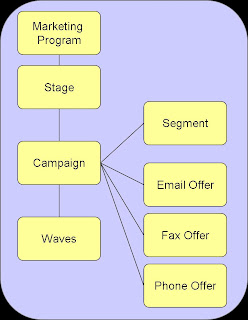
In older Siebel versions, we got familiar with Campaigns as being children of Stages, in their turn children of Marketing Programs. Segments and segment tree cells could be associated with the campaign. Moreover, when executing a campaign, multiple waves could be defined in order to ease up large volumes executions. Each campaign could have multiple Offers which were channel specific. Segment Trees were related with Stage, while Segment tree cells were related with campaigns. This structure is represented in the following diagram.


In Siebel 7.7 and 7.8, companies used to define objectives and plan budgets at a Marketing Program level. In a telecommunications company, decision makers can define a budget for a general win-back program, meant to gain customers that have churned in the past. This action is quite complex and can be split into several stages:
- allowing customers to come back without any supplementary fee;

- encouraging customers to return if they are not satisfied with current provider and terms; encouraging silver and gold customers to come back by offering them a 5% discount on certain services/ points / etc.;

- focusing on the gold customers that have changed provider and offering them a 10% discount reward for returning, etc.

Stages can also be temporal: if the customers connected in the first stage show interest to the offer but still do not decide to accept it, one can plan a second stage in which the customer is offered a 5% discount in order to come back. Moreover the stages can be recurrent, repeated twice a year in order to assure continuous customer win-back.
A campaign addresses specific customers and presents them a specific offer. It can have different offers and also the same offer can be linked with different campaigns. A first campaign, part of the first stage, can be implemented impacting all the customers that have left the company in the first month of the current year. The message for winning back the customers can be initially send via sms or email, based on the available contact details and customer stated preferences. A second campaign could address the same pool of customers, but the offer could be presented via phone (by the call center agents) and only for the customers that prefer this type of channel.

The just described organization of concepts determined some issues at application level such as:

- redundancy of campaigns for multi-channel offers – you had to construct different entities for transmitting the message across different channels;

- complex allocation of segments to offers as the relationship is mediated through campaigns and event through stages – there is no direct relationship between the offer and the entities receiving it, thus it is hard to track activities from a customer/prospect perspective;

- no relationship among across-channels activities for analysis purposes – as there is no link between offer and segment/lists, it is impossible to find out who received what especially if one is interested in an across channels overview;

- campaign history does not record which offer among several associated with the same campaign was actually presented.

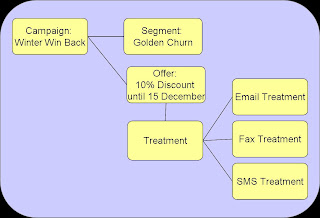
Siebel 8.0 introduces a new structure of concepts and different semanthic relationships. Campaigns are now understood as single stage communication to a specific group of customers or prospects. They can be stand alone or part of a multistage program. Offers are no longer linked with the channel, but represent just a single proposition sent to the target, hoping in an answer. A new structural concept is introduced: Treatments and they are children of offers. Treatments are channel-specific instances of an offer and include the associated content (channel specific). For this refer to the following diagram.

If a telecommunications company would like to make a campaign for winning back churned gold customers, with the campaign carried on during winter time, it can define an offer of 10% discount for the returning customers, if for example they come back until the 15th of December. The messages to the customers can be sent via various channels andin fact it is possible to define treatments such as Email message, SMS message and Fax message.

This new structure simplifies the process and facilitates the extension of the (same) campaign over several channels through multiple treatments. It also reduces data entry by enabling multiple segments targeting. Analyses are easier to carry on across campaigns and channels.
Moreover, Siebel 8.0 assures streamlines order management and loyalty integration by linking offers to product promotions and loyalty promotions. All this is backed-up by a series of enhancements: UI changes, business process and workflow changes, and data model changes.
From an end-user perspective, the application is now richer: new Offers and Allocation screens have been added. The new Offers screen provides the cross-channel “Offer” entity, while the association of treatments and offers is realized in the Allocation screen. Within the same campaign, one can allocate several segments, internal lists or segment trees, to one or more treatments linked with the campaign.
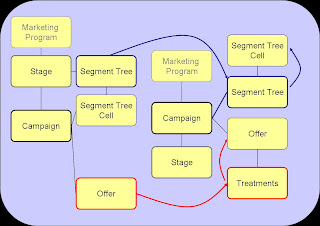
The Program Flow Designer has also been updated to have Segment Trees as children of Campaign, since the allocation rules have changed and you need to define a relationship among these elements. In prior versions, segment trees were allocated to stages being valid across campaigns (if needed). Another new feature is represented by the possibility of relating more than one segment tree to the same campaign. In this way it is possible to optimize the performance by splitting larger trees into smaller ones.

The structure changes also impact the business process and workflow level. In fact, the campaign load process differs by populating campaign ID and treatment ID for each contact, in the past editions it only populated campaign ID. Moreover, for each contact-treatment relationship a row is created in Campaign History, thus better storing the interactions with the customer/prospect.
All messages are now sent in the same wave. Stage execution workflow process is still available if one wants to execute several campaigns concurrently.

From a Data Model perspective, there are new relationships introduced: offer – treatments (parent:child, 1:M), offers – product promotions (M:1), offers – loyalty promotions (M:1).
The business component Response has suffered modifications to better support inbound interactions – the user key has changed as the treatment ID is required, while campaign ID is optional.
Campaign history populates treatment ID also based on allocations.
Segment trees are now linked at campaign level, in contrast with stage. Also multiple segment trees are supported per campaign, nevertheless deduplication against each other is not yet available.
The Campaign entity is now direct child of the Program one, while stage is an optional attribute of a campaign.

What does all this mean for your future upgrade?
The upgrade logic has to follow a certain path starting from the structural changes employed. Offers created in versions prior to 8.0 are preserved and transformed in “Treatments” and a parent offer with same attributes is automatically created for each “new” treatment.
The campaign history registers the primary offer for campaign in S_CAMP_CON.
Segment and segment trees that have been allocated in Siebel 7.7 and 7.8 also suffer modifications. If a segment tree cell was associated to a campaign, during the upgrade process the segment tree is associated with the campaign. The segment tree cells are then associated to the primary treatment for the campaign.
At least, responses are not impacted by the new improvements.

At a first glance it seems that Oracle has improved the functionality presented in prior Siebel (7.7 and 7.8) editions. However, the change in relationships and structure of concepts can be cumbersome for the IT specialists used to Siebel Marketing, at least at the beginning.